
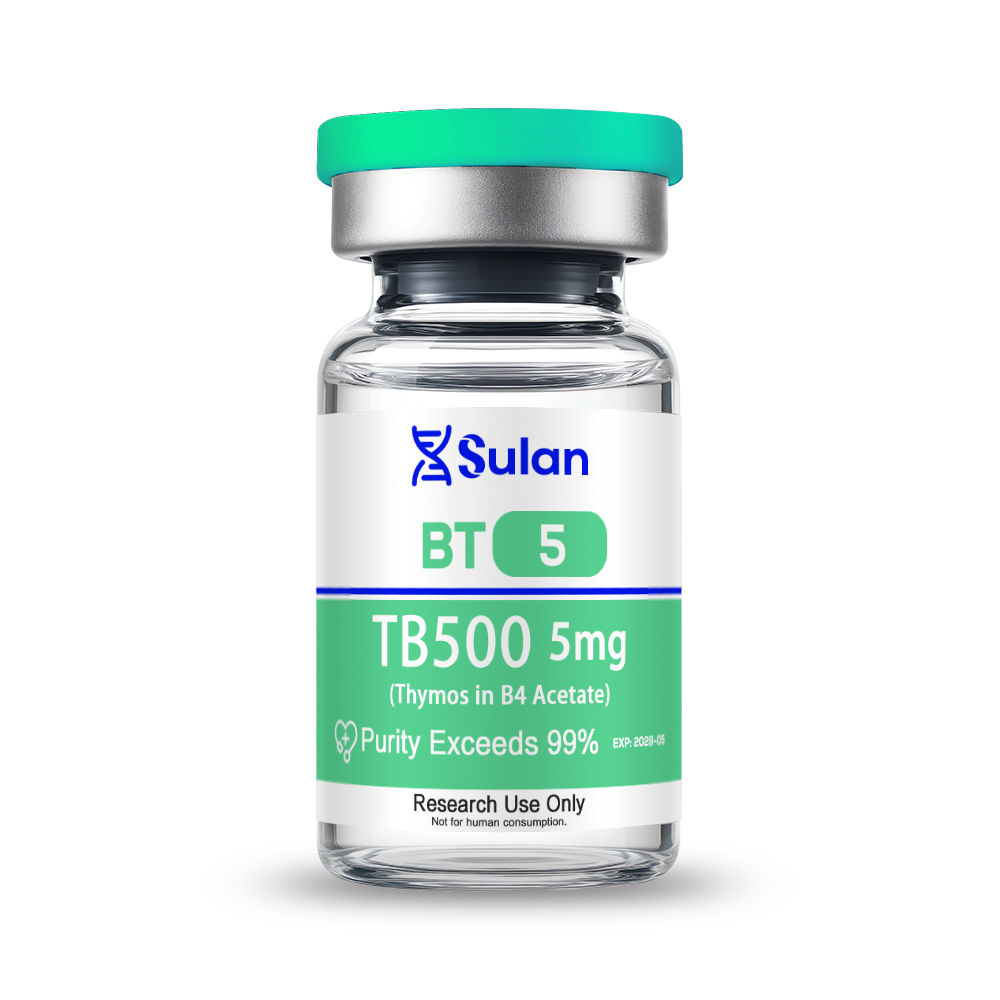
TB-500 (Thymosin beta 4)
This price is for one box, with ten pieces per box
- only 42 left in stock
- 20 people are viewing this right now
- 198 people has purchased this in 7 days
 Returns & Exchanges within 30 daysAny return for unsatisfied item(s) is available within 30 days
 Money Back GuaranteeA full refund within one week upon receiving your return
 3-Month WarrantyCovering any possible defect in materials and workmanship
 Safety AssuranceOur products are strictly tested and quality assured


TB-500 Peptide
TB-500 peptide, also known as synthetic Thymosin Beta 4 or Tβ4 is the synthetic version of the naturally occurring protein Thymosin beta 4. The latter is found naturally within the cells of the thymus organ and encoded by the TMSB4X gene. Researchers have suggested TB-500 peptide hosts similar potential as Thymosin beta 4. These potential mechanisms of action may include inducing angiogenesis, elevating wound healing, or possibly elevated metastatic potential of tumor cells and hair growth.
Besides being highly soluble in water and light in weight, TB-500 is a 43 amino acid-containing peptide found in abundance in the wound fluid comprising multiple blood platelets. This peptide may exhibit possible anti-inflammatory potential and may support neurological healing, as well as potentially supporting healing processes in the spinal cord, heart, and epidermis. (1)
Overview
TB-500 peptide, also known as thymosin β(4), includes a distinct peptide segment (17)LKKTETQ(23), which acts as the active site and which researchers consider potentially impactful in actin binding, cell migration, and wound healing. (2) The amino acid sequence of TB-500 is: Ac-Ser-Asp-Lys-Pro-Asp-Met-Ala-Glu-Ile-Glu-Lys-Phe-Asp-Lys-Ser-Lys-Leu-Lys-Lys-Thr-Glu-Thr-Gln-Glu-Lys-Asn-Pro-Leu-Pro-Ser-Lys-Glu-Thr-Ile-Glu-Gln-Glu-Lys-Gln-Ala-Gly-Glu-Ser-OH.
Actins are essential proteins that form a key component of the cytoskeleton within cells, serving not only to maintain cellular structure but also to facilitate various cellular functions, including movement. Actin is suggested to be critical in supporting these cellular structures and processes. Thymosin beta-4 and, thus, TB-500 are believed to interact with actin, potentially by binding to globular actin (G-actin), a precursor to filamentous actin (F-actin). This interaction is thought to hinder the transformation of G-actin into F-actin, a process known as actin sequestration, and is likely to increase the av