
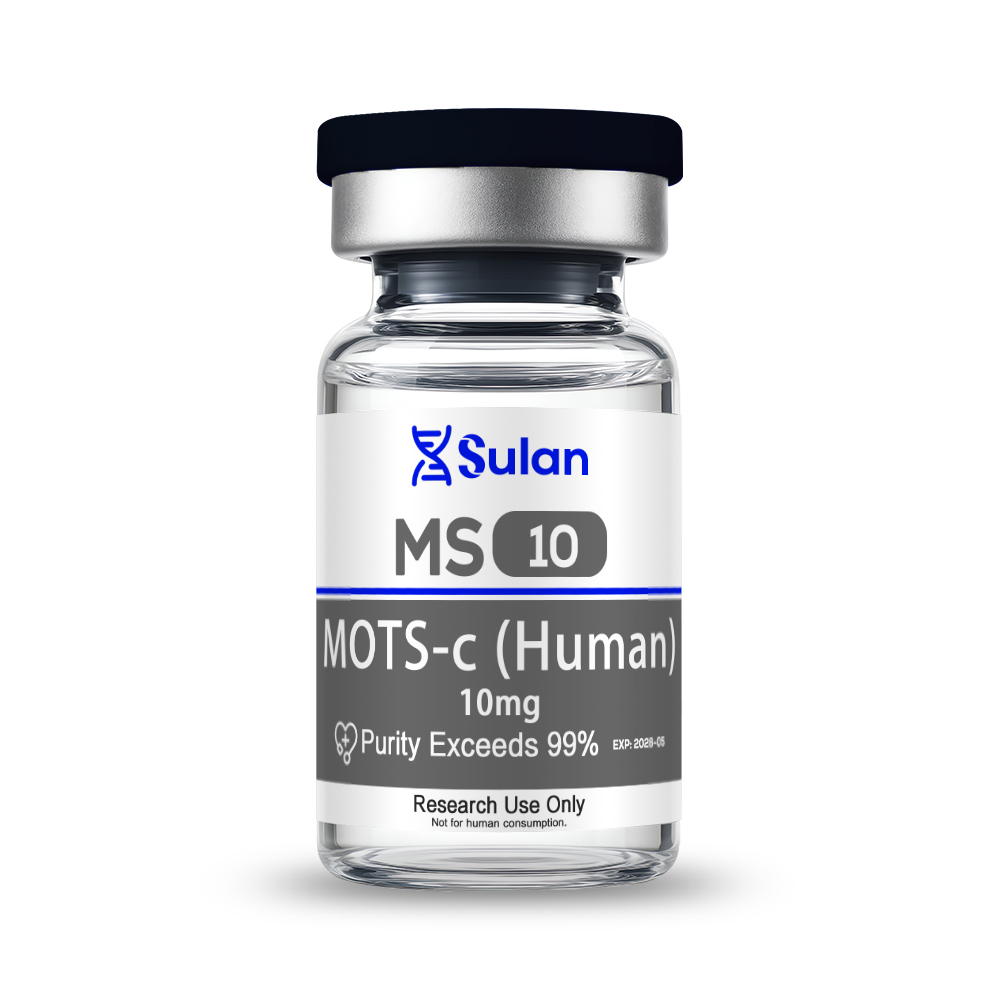
MOTS-C
This price is for one box, with ten pieces per box
- only 45 left in stock
- 44 people are viewing this right now
- 261 people has purchased this in 7 days
 Returns & Exchanges within 30 daysAny return for unsatisfied item(s) is available within 30 days
 Money Back GuaranteeA full refund within one week upon receiving your return
 3-Month WarrantyCovering any possible defect in materials and workmanship
 Safety AssuranceOur products are strictly tested and quality assured


MOTS-c Peptide
MOTS-c (mitochondrial open-reading-frame of the 12S rRNA-c) peptide is a novel mitochondria-derived peptide. It is a short peptide composed of 16 amino acids, expressed in tissues and plasma, indicating a cell-specific and hormonal role. (1) With the potential to work both as a cell-specific compound and as a hormone, this peptide possibly acts by stimulating the AMP-activated protein kinase (AMPK) pathway. Only two mitochondrial-derived peptides (MDPs) have been studied, Humanin and MOTS-c. When metabolic stress occurs in the organism, the peptide is believed to translocate to the cellular nuclei and alter the gene expression. MOTS-c peptide may also be released extracellularly and is known as “ mitochondrial hormone ” or simply as “ mitokine. ” (2)(3)
Chemical Makeup (4)
Molecular Formula: C 101 H 152 N 28 O 22 S 2 Molecular Weight: 2174.64 g/mol Other Titles: Mitochondrial-derived peptide MOTS-c, Mitochondrial open reading frame of the 12S rRNA-c
Research and Clinical Studies
Animal research models have indicated multiple potential actions from MOTS-c peptide, including increased physical performance, regulated cellular and tissue metabolism, and myoblast adaptation. (2) Research suggests that these actions may primarily depend on age and age-related changes in MOTS-c expression. The researchers suggest MOTS-c levels and activity might decline, hinting at a role in the cell aging process and the development of age-related metabolic dysfunction. Furthermore, MOTS-c may interact with known aging regulators, such as NAD and sirtuins, suggesting its involvement in pathways potentially modulating the lifespan of the cell. (1) As per Joseph C Reynolds et al., “Mitochondria are chief metabolic organelles with strong implications in cell aging that also coordinate broad physiological functions, in part, using peptides that are encoded within their independent genome.” (4) The peptide endogenous expression has also been posit