
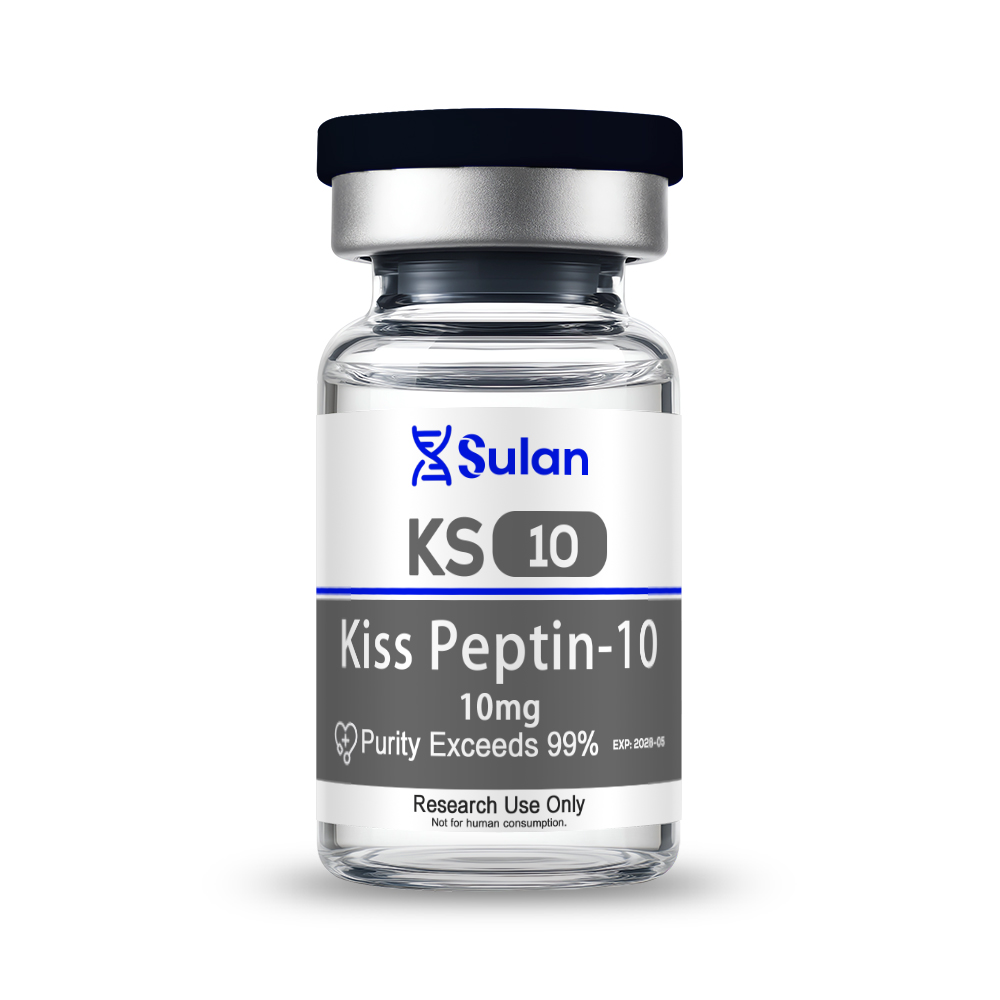
Kisspeptin-10
This price is for one box, with ten pieces per box
- only 48 left in stock
- 36 people are viewing this right now
- 416 people has purchased this in 7 days
 Returns & Exchanges within 30 daysAny return for unsatisfied item(s) is available within 30 days
 Money Back GuaranteeA full refund within one week upon receiving your return
 3-Month WarrantyCovering any possible defect in materials and workmanship
 Safety AssuranceOur products are strictly tested and quality assured


Kisspeptin-10 Peptide
Kisspeptin-10 is a naturally occurring peptide protein encoded by the KISS1 gene. (2) Kisspeptin is a product of the KISS1 gene, produced by the cleavage of the original 145-amino acid polypeptide to a smaller peptide. This smaller peptide, composed of 54-amino acids, is cleaved further to become Kisspeptin 45-54, also known as Kisspeptin 10. (6)
KISS1 is a gene that is considered to suppress metastases of melanomas and breast carcinomas, thereby inhibiting abnormal cell growth and potentially preventing cancer. (2) Initially considered to be a metastasis suppressor, Kisspeptin-10 was later suggested to possess a different expression profile, which may potentially allow it to function on the hypothalamus and pituitary gland, thereby impacting the reproductive system. (3)
Several independent studies in the mid-2000s suggested that Kisspeptin-10 may play a role in hypogonadotropic hypogonadism, as the peptide is considered to be a ligand of the G-protein coupled receptor 54 (GPR54). (5) Research continues to explore this potential aspect of the Kisspeptin-10 peptide.
Hypogonadism is a system disorder wherein reproductive organs produce less or no sex hormones. One of the forms of hypogonadism is called hypogonadotropic hypogonadism, where the organism suffers from hypogonadism due to under-functioning of the pituitary gland or hypothalamus. (1) GnRH is considered to stimulate the pituitary gland to release follicle-stimulating hormone (FSH) and luteinizing hormone (LH). Both FSH and LH are considered to regulate reproductive function. (1) Lack of these hormones, i.e. GnRH, FSH, and LH, are considered the main factors of hypogonadotropic hypogonadism.
Overview
GPR54, also called the KISS1 receptor (KISS1R), (7) has been suggested by researchers to be an important GnRH receptor. (1) They further suggest that Kisspeptin-10 exhibits action by possibly binding to GPR54 receptors, which may activate the reproductive axis by st