
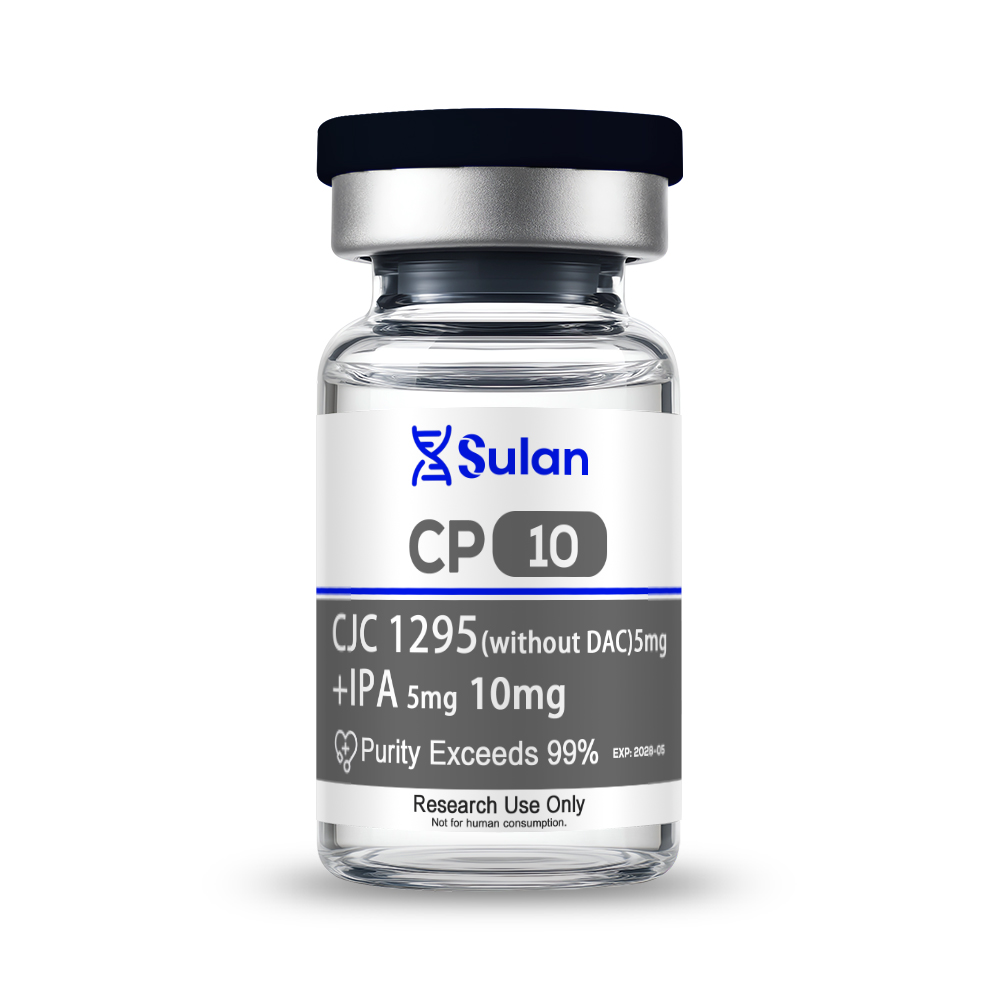
CJC-1295 Whitout DAC (5mg) IPA (5mg)
This price is for one box, with ten pieces per box
- only 28 left in stock
- 45 people are viewing this right now
- 298 people has purchased this in 7 days
 Returns & Exchanges within 30 daysAny return for unsatisfied item(s) is available within 30 days
 Money Back GuaranteeA full refund within one week upon receiving your return
 3-Month WarrantyCovering any possible defect in materials and workmanship
 Safety AssuranceOur products are strictly tested and quality assured


CJC-1295 & Ipamorelin Peptide Blend
Ipamorelin and CJC-1295 are both considered to be growth hormone secretagogues. Ipamorelin is a synthetic pentapeptide, (1) and CJC-1295 peptide consists of 29 amino acids. (2) Ipamorelin appears to fall into a category of peptides classified as growth hormone secretagogues (GHSs). These are peptides that are assumed to stimulate the release of the growth hormones, however are not considered growth hormone releasing peptides themselves. On the other hand, CJC-1295 has also been suggested by researchers to stimulate the release of growth hormone, primarily by mimicking the actions of the naturally occurring growth hormone-releasing hormone (GHRH). Both Ipamorelin and CJC-1295 peptides have been assigned by researchers to this class, studied for similar potential actions and apparently differing only in terms of their half-life and pharmacokinetic profiles.
Overview
CJC-1295 & Ipamorelin peptides both are suggested by researchers to augment the levels of the growth hormones through a possible triggering of the anterior pituitary gland. Scientists consider that once triggered, growth hormones may be naturally secreted, maintaining levels of growth hormones in the organism. (3)
CJC-1295 peptide is a tetrasubstituted version of GHRH 1-29, developed to represent the shortest functional sequence of GHRH. GHRH 1-29 consists of the first 29 amino acids of the native GHRH peptide, and may potentially stimulate growth hormone production in pituitary gland cells, called somatotrophs. The peptide has four amino acid substitutions in its structure, which scientists suggest may enhance its activity and resistance towards proteolytic enzymes. More specifically, the amino acids which are replaced appear to be the 2nd, 8th, 15th, and 27th amino acids. Owing to these substitutions, the peptide might be able to bind covalently to blood albumin, with trace amounts possibly able to bind to fibrinogen and immunoglobulin G (IgG).