
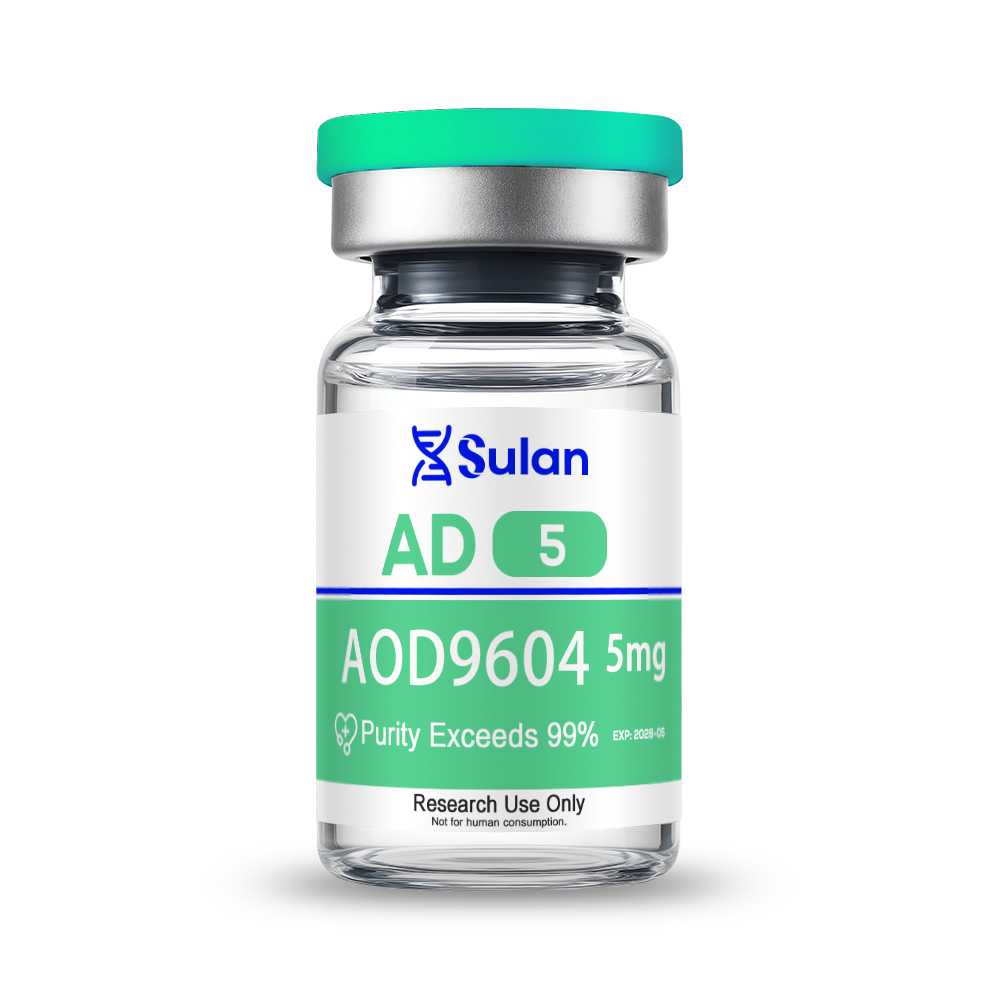
AOD 9604
This price is for one box, with ten pieces per box
- only 24 left in stock
- 8 people are viewing this right now
- 227 people has purchased this in 7 days
 Returns & Exchanges within 30 daysAny return for unsatisfied item(s) is available within 30 days
 Money Back GuaranteeA full refund within one week upon receiving your return
 3-Month WarrantyCovering any possible defect in materials and workmanship
 Safety AssuranceOur products are strictly tested and quality assured


AOD 9604 Peptide
AOD 9604 peptide is a synthetic analog of growth hormone designed with the intention of mitigating obesity and aiding weight loss. The peptide is a modified fragment of the growth hormone where the last 16 amino acids (176-191) have been reproduced as a specific peptide, called GH Fragment 176-191 or simply AOD 9604. It also has a tyrosine residue to replace the first amino acid at the N-terminus, which researchers consider to help increase the stability of the peptide. (1)
More specifically, AOD 9604 is considered the lipolytic fragment of GH as different parts of the GH molecule appease to have different potentials. For instance, studies suggest that out of its 191 amino acid structure “ the N-terminal region exhibits an insulin-potentiating action, while amino acids 108 – 129 of hGH were found to evoke high mitogenic responses. ” (2)
Overview
AOD 9604 peptide was developed in the 1990s in an effort to develop proteins which might exhibit anti-obesity properties similar to Growth Hormone (hGH). Rigorous scientific studies and experiments have since been conducted to determine the potential action of AOD 9604 in lipolysis. (1) Lipolysis is a term to describe the process through which stored fats or triglycerides in fat cells are broken down into glycerol and free fatty acids, which may be used as an energy source by other cells. Enzymes such as lipase appear to play a critical role in this process, helping in the breakdown of these fats. It’s possible that AOD9604 may influence the fat cells and lipolytic receptors, particularly given its observed association with changes in weight and fat in murine models. Research study findings indicate that the fragment seems to have the capacity to amplify lipolytic sensitivity following its introduction. Furthermore, the study hypothesizes a potential interaction of AOD9604 with the beta-adrenergic pathway, especially concerning the beta(3)-adrenergic receptors (beta(3)